

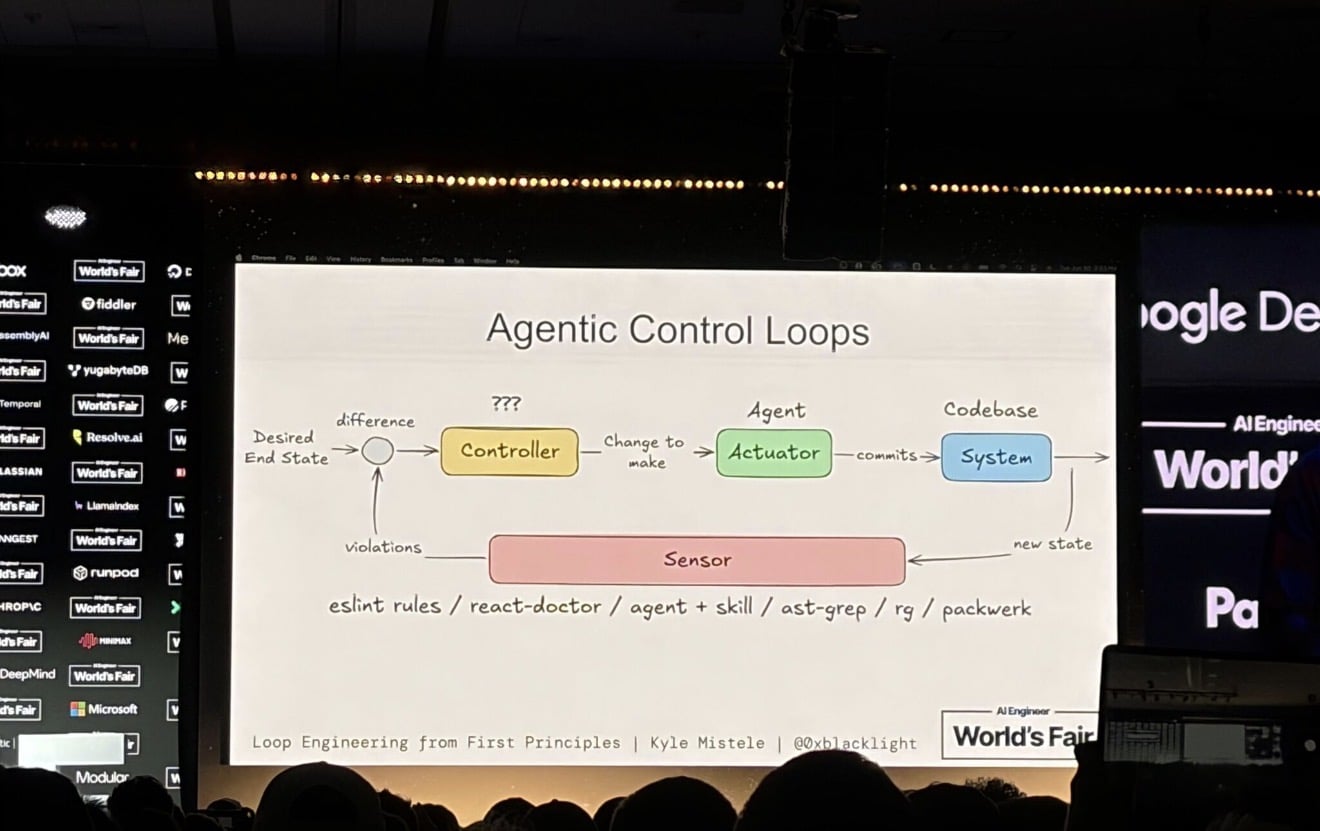
I was at the AI Engineer World’s Fair in San Francisco a few weeks ago, and one phrase was everywhere: loops. The line everyone riffed on came from Claude Code creator Boris Cherny in an earlier talk: “I don’t write prompts for Claude anymore. … My job now is writing loops.”
As an engineer, I was both skeptical and intrigued. While I haven’t figured out how to replace my entire job with “loops” yet, like any good engineer, I started with an MVP for my daily SDLC “loop.”
Here’s how I think of a loop: a recursive goal. Define a purpose, and the AI iterates until complete.
Assumptions on Tooling
These are the tools my team and I use; substitutes work just as well.
- Claude Code.
- GitHub for issue tracking.
- The
ghCLI, with its built-ingh api graphql. jqandgit.- Agent Skills.
The Heartbeat Is a Schedule
Without a schedule, a loop is a one-off script. Mine is a Claude Code scheduled task firing at 8 a.m. and noon, with a one-line prompt: the /start-issues skill.
The skill keeps this maintainable: I describe the workflow once and change it by editing one file, not a schedule prompt I’ll forget about. It decouples what from when: to pick up an issue now, I open a session and run /start-issues by hand.
Feeding the Loop
Each firing asks our board one question: which issues are In Progress, assigned to me, and labeled auto? Nothing is touched by default; adding auto is how consent enters the system.
Who applies the label? Still me, deliberately. Human-in-the-loop really matters here: if agents picked up every issue in our backlog, it would quickly spiral into chaos.
QAs file bugs into a triage column; I look for candidates that are well-defined with screenshots, small in scope, and built on established codebase patterns. Agents shine following patterns, not inventing them.
I layer my notes into the issue: the module the bug lives in, a similar past fix, as much context as I can give the agent. We’ve written about this in another blog post: your best prompt is a well-defined user story.
When it’s hand-off ready: In Progress, assigned to me, auto on. That’s exactly what the script checks, via the board’s GraphQL API filtered with jq:
| select(.content.assignees.nodes | map(.login) | index($viewer))
| select(.content.labels.nodes | map(.name | ascii_downcase) | index("auto"))
| select(.fieldValues.nodes
    | map(select(.field.name == "Status" and .name == "In Progress"))
    | length > 0)
Isolation Through Worktrees
Each claimed issue gets an isolated worktree, so parallel agents don’t step on each other’s files.
git worktree add -b issue-4132-empty-state-fix ../app-issue-4132 origin/staging
The Claude Code desktop app makes this simple with a checkbox.
Where the Loop Comes Alive
By now the agent has every word of context the QA and I loaded into the story. It writes a short plan, implements tests-first then the fix, and opens a draft PR. Then the feedback loop: the skill has it watch CI for lint failures, failing tests, and feedback from our code review agent, addressing everything until green.
False positives come back to me. Verification is still on me; the more the loop runs, the more tempting it is to accept whatever comes back. That’s a quiet kind of debt. Every change I accept unread moves the codebase a little further from the version in my head.
Why Human-in-the-Loop Is Still Most Important
Do loops automate tasks and let me do more? Yes. Are they right for every use case? Absolutely not. Plain prompting is still just as effective for plenty of work, and most of mine still involves it; it’s about balance.
Models like Fable 5 and GPT-5.6 are increasingly good at long-running tasks and producing code that looks great on the surface; our job is shifting toward reviewing code rather than writing it, so we must do this well.
Build the loop, but stay the engineer: rely solely on loops and stop reviewing code, and product quality will suffer. Be the engineer who adds value, not debt. A loop that passes the thinking off to someone else on your team isn’t adding value.
Is the buzz justified? I’d say so. Loops buy leverage, but the judgment stays yours.