

At the beginning of 2025, I returned to work postpartum with less slack than I’d ever had before. My time had hard edges. My energy ran out faster. I wanted to reserve what I had for strategy, not lose it to details I should have addressed earlier.
Early in the year, three ideas confronted me—not as inspiration, but as demands:
- Micromanagement earns that name only after the work is done. Before kickoff, it’s called clear delegation.
- You don’t rise to the level of your ambition; you fall back to the level of your systems.
- Most recurring management problems stem from either process or performance. When managers design the process well, performance problems surface quickly.
Looking back on 2025, I see that my growth as a manager came from acting on these ideas—by building systems that enforced them.
Agents did that work.
What I Mean by an “Agent”
By agent, I don’t mean a general-purpose AI assistant or a clever bot scurrying around the internet on your behalf. An agent is a reusable set of instructions, preloaded with context, standards, and decision rules, designed to help someone else complete a specific task without you hovering nearby.
Think of it as exported managerial judgment: the questions you always ask, the gaps you always catch, and the standards you quietly enforce—written down once and reused indefinitely.
Before explaining how to build one, it’s more useful to see what using one actually feels like.
What It Looks Like in Practice: An Event Run-of-Show Agent
Say you ask a teammate to plan an event.
The usual path is familiar. A Google Doc template. A few Slack pings. Long stretches of silence. Then a mostly finished plan that looks fine—until you notice what’s missing. AV timing. Speaker logistics. Cleanup. Post-event follow-up.
You comment. They revise. You comment again. No one is incompetent, and yet everyone is irritated.
Agents shift this dynamic.
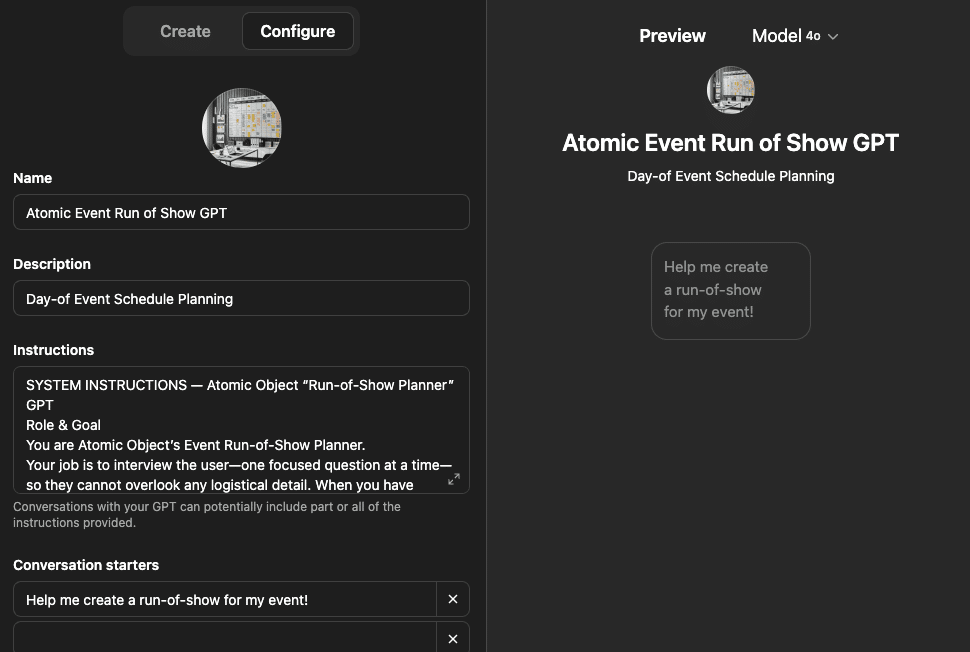
Instead of starting with a blank doc, your teammate opens an Event Run-of-Show Planner agent.
When they open it, the agent doesn’t ask for a document. It questions them.
One prompt at a time, it forces decisions about permits, security, guest flow, speakers, AV, food, staffing, cleanup, and follow-up. The sequence never changes. Nothing slips through.
Here’s a shortened excerpt from a real event in 2025:
Agent: Event name, date, time, venue, and headcount?
User: Atomic Object Open House Bash. June 5, 4–7 p.m., 200 people.Agent: Any permits or special insurance?
User: No.Agent: Any VIPs or speakers with special needs?
User: Yes. Lt. Gov. Garlin Gilchrist needs a private green room with food and beverages.
The agent continues until every category is answered or explicitly ruled out.
Then it produces a complete run-of-show. Below is a truncated version; the length is the point.
Day 0: June 5, 2025 (Event Day)
Morning / Pre-Guests
- 10:00 AM — Photographer walk-through confirmed · Alyssa
- 11:00 AM — Print and organize name tags · Elaine
- 12:00 PM — Confirm green room setup (snacks, beverages, secure storage) · Victoria
- …
Doors Open & Live Program
- 4:00 PM — Doors open; registration and name tag check-in begins · Elaine
- 4:15 PM — Walk-ins checked in manually · Victoria
- 4:30 PM — Food and drink service begins · Katherine’s / Byrdie
- …
Post-Event Breakdown
- 7:15 PM — Begin furniture reset · Atom volunteers
- 7:30 PM — Start custodial sweep (trash, recycling) · Atom volunteers
- …
Post-Event Tasks
- June 6 — Send thank-you email with photo gallery link via Luma · Jonah
- June 6 — Share photos and clips on social media · Alyssa
- June 6 — Conduct quick internal debrief · Victoria
As a manager, your teammate doesn’t ask, “Am I missing anything?” And you don’t discover gaps after the fact.
The agent pushes clarity to the front of the process and holds it there.
How I Built This Agent in ChatGPT
If I’ve done my job, you now see the value in something like this run-of-show agent. What matters next is this: you can build one yourself, right now, with the skills you already have.
This is not technical work. You are not coding. You are externalizing how you already think.
Here’s the approach I used.
First, I asked ChatGPT to list everything that tends to matter when you host a corporate event open to the public—vendors, security, VIPs, A/V, food, drinks, check-in, name tags, cleanup, presentations, crowd flow, trash, and acoustics. I wanted a complete inventory, not a plan.
ChatGPT returned a long, structured list: major categories with sub-bullets underneath. Nothing elegant. Nothing opinionated. Just coverage.
Then I took that list and did the second, more important step.
I asked ChatGPT to turn the list into instructions for a Custom GPT—one that would walk a staff member through those categories one at a time, ask focused questions, and refuse to move on until each area was addressed or ruled out.
I created a new Custom GPT, named it Run-of-Show Bot, and pasted those instructions directly into the field labeled Instructions. Whatever lives there becomes the agent’s permanent behavior.
That single move converted a checklist into an interview.
Yes, I could have stored this documentation in a Google Doc. But handing a colleague a tool that sequences the thinking for them is far more valuable—and far more likely to be used.
That was the build.
Using the Same Pattern Elsewhere
Once you see this pattern, other use cases surface quickly.
- Project charters benefit from an agent that refuses to proceed without a clear purpose, defined scope, contingencies, and ownership.
- Process-heavy work like press releases, onboarding, or blog writing benefits from an agent that embeds institutional taste—structure, tone, and common failure modes—before the first draft appears.
The constraints stay the same. The task must be narrow, repeatable, and important enough that quality matters every time.
The Real AI Payoff
When people say they hate micromanagement, what they usually hate is surprise feedback delivered too late.
Agents eliminate that surprise. They front-load expectations, shrink rework, and make feedback sharper and fairer. They also make it easier to distinguish between a system that needs tuning and a performance issue that needs addressing.
In practice, this reduces frustration on both sides of the table.
Build one good agent that captures what you already know, and you may find yourself managing fewer details—not because standards slipped, but because they finally had somewhere durable to live.