

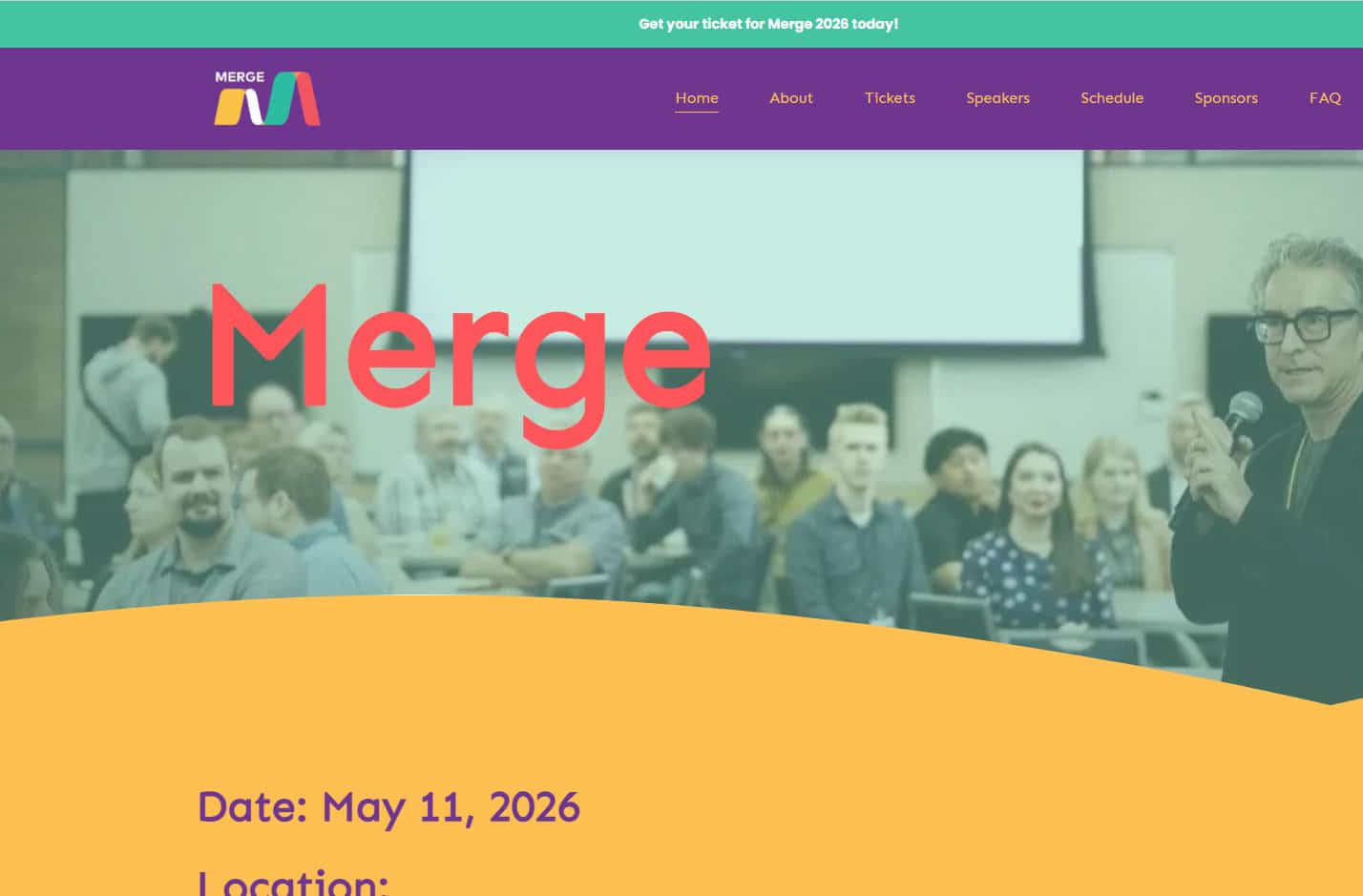
Every year, the Merge conference in Grand Rapids brings together software developers, designers, product leaders, and technology professionals from across West Michigan to discuss how our industry is changing. Organized by Software GR, the conference has become a space for practical conversations about software development, collaboration, leadership, and emerging technology trends.
For the past few years, I have had the opportunity to serve on the planning committee for Merge, with Atomic Object participating as a conference sponsor. Helping plan and execute the conference gave me a chance to spend more time thinking not only about individual talks, but also about the broader themes emerging across the schedule. This year, I spent some time reflecting on the changes in the artificial intelligence landscape over the past year.
Last year, many conversations about AI in software development felt exploratory. Teams were experimenting with new tools, testing workflows, and trying to understand what generative AI might mean for the future of product development. The questions were broad: Should we adopt these tools? Where do they fit? Are we all becoming “vibe coders” now?
At Merge 2026, the tone felt noticeably different. AI wasn’t presented as a novelty or a future possibility. It was treated as a reality of the way we work now. The conversation has shifted from whether teams should use AI to how teams use it effectively. In my mind, that shift says a lot about where the industry is heading.
2025’s take on AI
Looking back at Merge 2025, many AI-related talks focused on helping teams approach AI thoughtfully amid the growing hype and lingering uncertainty. Talks had topics like “Smart Adoption, Not Blind FOMO,” framing AI as a trendy tool that still needed integration into existing workflows. The emphasis was on avoiding too much disruption, protecting team dynamics, and considering the tradeoffs that came with rapidly changing tooling and not falling into the trap of maximizing output at all costs.
Other talks approached AI through the lens of integration and collaboration. One talk described AI as a “universal translator” that could help bridge communication gaps between systems and teams. Another warned about the risks of runaway code generation and increasingly fragmented systems. Across these talks, a common thread emerged: teams were trying to figure out how AI fit into existing practices without destabilizing them.
The underlying question in 2025 seemed to be: How do we adopt AI responsibly?
That question reflected the broader feeling of the industry at the time. AI tools were rapidly improving, but many organizations were still experimenting at the edges. There was excitement, but also caution and uncertainty.
The AI Landscape of 2026
A year later, the conversation has changed quite a bit. At Merge 2026, speakers were no longer encouraging teams to adopt AI. Instead, they assumed AI was already integrated into day-to-day work and focused on the experiences and consequences of that reality.
The questions became more concrete:
- How do we maintain quality in AI-assisted workflows?
- How do we supervise increasingly autonomous systems?
- What happens to engineering discipline when code generation becomes cheap?
- How do teams preserve trust and shared understanding?
Several talks reflected on this transition directly. Drew Colthorp’s session on moving from “vibe coding” to “agentic engineering” focused on keeping humans in control of increasingly capable AI systems. Rather than treating AI as a replacement for engineering rigor, this talk emphasized the need for structure, oversight, and intentional workflows.
Another talk, provocatively titled “TDD is Dead! Quality Code in the Age of AI” argued that specifications and clear expectations become even more important when AI is involved. Ambiguity that might once have resulted in a small misunderstanding between developers can now generate entire layers of incorrect implementation faster than ever before.
The most interesting shift between 2025 and 2026 was not that AI became more capable. It was that the conversation became more disciplined.
The New Anxiety Is Trust
One theme that appeared repeatedly across this year’s talks was trust.
As AI systems become more integrated into software delivery, teams are wrestling with a new set of concerns:
- Can we trust generated code?
- Can we maintain architectural clarity?
- Can we identify hallucinations quickly enough?
- Who is accountable for mistakes?
- How do we avoid accumulating invisible complexity?
These concerns are different from the hype-driven conversations that dominated the industry a year ago. They reflect practical experience. Teams have now spent enough time using AI-assisted workflows to understand both the productivity gains and the hidden costs. AI can accelerate output, but it does not necessarily improve judgment.
That may explain why several Merge talks emphasized practices that experienced software teams already value:
- Clear communication
- Iterative feedback loops
- Testing
- Observability
- Architectural simplicity
- Collaborative review
- Shared understanding across disciplines
None of those practices became obsolete because of AI; instead, they became more important. As implementation becomes faster and cheaper, cross-team collaboration, clarity, and feedback cannot be undervalued.
AI Is Reshaping Collaboration More Than It Is Replacing People
Another interesting pattern across the Merge 2026 schedule was the new take on cross-functional collaboration. Several talks explored how AI is changing the boundaries between design, development, and product work. Developers can prototype interfaces more quickly. Designers can explore technical ideas more independently. Product teams can generate artifacts and synthesize information faster than before.
AI lowers the friction involved in crossing disciplines. But lowering friction is not the same thing as eliminating expertise. In practice, these tools seem to increase the importance of context, alignment, and decision-making. Teams still need shared understanding around user needs, product goals, architectural tradeoffs, and quality standards. One of the more compelling ideas in this year’s conference was that AI brings the disciplines of product, design and developement closer together.
What AI Adoption Looks Like in 2026
If there was a consistent message across Merge 2026, it was that the current state of AI adoption is less about maximizing automation and more about building disciplined systems around it. The teams most likely to succeed with AI probably are not the ones generating the most code or adopting the newest tools first. They are the ones creating strong feedback loops, maintaining accountability, and preserving space for human judgment.
Mature AI teams:
- Treat AI as augmentation rather than autonomy
- Prioritize clarity and specification
- Preserve review and verification practices (aka testing)
- Invest in collaboration
- Recognize that velocity without validation creates fragility
That perspective felt noticeably more grounded than many AI conversations, even from just a year ago.
What encouraged me most about this year’s conference was not the excitement around AI itself, but the growing focus on collaboration, accountability, and craftsmanship. Conferences like Merge are valuable not because they predict the future perfectly, but because they help us compare notes as an industry while the future is still unfolding. I’m curious to see where the conversation goes next.