


Article summary
Imagine this…
A company unveils a brand new, high-tech laser cutter.
It’s cutting-edge technology (if you’ll pardon the pun): incredibly strong, incredibly practical, incredibly easy to use. People are fascinated; this is so cool!
People start cutting out their designs in the laser cutter. They see what everyone else is doing and get ideas. They take inspiration from handmade crafts and older forms of art, trying to recreate them on the laser cutter. Soon, they start straight-out copying and cutting out other people’s designs. There’s a boom in crafting and in the market.
Then some people get mad that people are cutting out their designs in the laser cutter without asking for permission. Handmade crafts that used to sell for hundreds of dollars suddenly find a saturated market of high-tech laser-cut copies.
Meanwhile, someone sticks their finger into the laser just to see what would happen and gets burned. Someone else finds this incredibly funny and convinces other people to stick their fingers in. People are outraged: they say the laser cutter company should add better safeguards so people find it harder to stick their fingers in the laser. The laser cutter company says people should stop being careless enough to stick their fingers in the laser. People fire back, saying that they would be significantly less likely to stick their fingers in the laser if there were signs saying not to. The laser cutter company says they’ll have to buy a whole new label machine, and who will cover the costs?
Simultaneously, someone realizes that a strong, portable laser that can cut through wood and metal could be incredibly useful for all sorts of things, a significant number of them highly illegal.
Then a particularly adventurous group of middle schoolers decides laser tag would be way more fun with actual lasers. And hey, their school just got this incredibly convenient new laser cutter…
The Issue With Power Tools
Power tools are dangerous for a wide variety of reasons. They are also incredibly beneficial in very specific contexts. They are often used and developed by highly specialized teams, but basically any layperson can pick them up at their own risk.
Does this sound familiar? It should, because it’s similar to the current paradigm of AI use. Generative AI is an incredibly powerful tool that is highly beneficial in a wide variety of contexts. Highly specialized teams are often the ones using and developing new artificial intelligence tools, but basically anyone can use a chatbot. AI often carries the risk of dependence, breaches of privacy, and other legal infringements. In short: AI is a very particular new kind of power tool.
We know our existing power tools often have a lot of safeguards and regulations, legal and otherwise. Unfortunately, AI currently lacks all of those things. Laws and expectations currently scramble to keep up with a rapidly changing technological and social environment.
This lack presents us with an opportunity: if we step back and treat AI like the aforementioned laser cutter, what conclusions can we draw about the necessary safeguards and growth trends of this new kind of power tool?
The Ignorance Problem
Given the incredible variety of potential problems new technology often presents, let’s focus for now on a very particular one: the ignorance problem.
We can all agree that lasers are dangerous, and that you probably don’t want to stick one in your eyes. However, their sense of danger stems from the fact we generally know the harm they can do. If you stick a laser in your eye, you run the risk of going blind. The real danger comes from people who don’t know this fact, and might stick a laser in their eye out of curiosity or simple ignorance.
For AI, the vast majority of the population can be considered ignorant.
The simple fact is that we don’t yet know the full extent of the possible harm from AI. What we do know is often niche and not very widespread. How many of us read psychology journals or follow educational articles about experimental trends? How many of us can quantify what happens to the brain or to social skills with extended AI use? It’s just too new. Most of us, however, can say exactly what happens if you stick a laser in your eye: you go partially blind.
We’re all in danger of unknowingly sticking metaphorical lasers in our eyes simply because we don’t understand the dangers of AI.
Lasers in laser cutters, when used improperly, can harm, burn, and even seriously blind. In a similar vein, datasets can seriously infringe on individuals’ privacy and cause harm through misinformation, a more metaphorical blindness.
That’s not to say lasers or AI are entirely horrible. We use laser cutters for education, construction, manufacturing… The list goes on. Table saws are highly dangerous due to the high risk of injury, but they are one of the most invaluable power tools in a shop when used correctly and cautiously. Similarly, AI can have incredibly beneficial effects when used carefully. We have already seen some of the benefits in medicine, education, algorithms, research, and so on.
Just like how the hypothetical middle schoolers don’t understand the actual danger threshold of powerful lasers and think they would be a fine addition to Laser Tag, the ignorance problem stems from the fact that we just don’t know what we’re using or how.
Solutions
Fortunately, ignorance isn’t a permanent condition. The power tool industry also offers solutions to these problems: label the risks, teach the fundamentals, and leverage social norms to fill in the safety gaps.
Labeling
As a near-ubiquitous feature of most commercially-available power tools, labels are always a good idea. We have actually seen this principle in action already. Most AI tools now include small footnotes warning of the bots’ ability to hallucinate. For example, Claude has “Claude is AI and can make mistakes. Please double-check responses.” in fine print underneath the prompt bar.
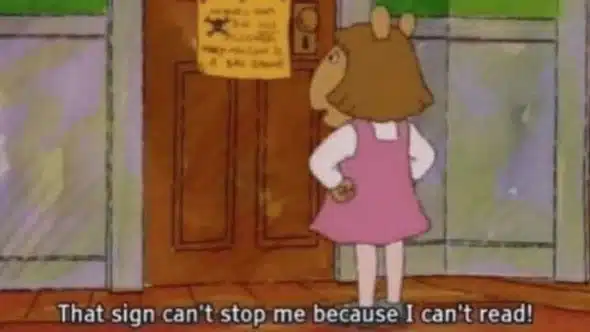
However, labels aren’t always useful. In fact, they could be considered something of a liability-dodging scheme. Often, we get so used to seeing warning labels that our eyes glaze over them. After all, how many of us actually read the Terms and Conditions all the way through before signing?
Education
We’ve said it over and over: we need more education on how to use our AI tools responsibly. Every single maker space and construction shop requires users to attend a basic safety and instructional class before using the tools. Some even require entire courses, and supervision afterwards. Few of us would give a power drill to a middle schooler with no instruction.
If they don’t know they shouldn’t point the rotating bit of a drill towards their friends, it’s very likely that someone is going to get hurt. Likewise, people don’t know what they are actually doing with AI before they learn the consequences. Sure, they might still make bad decisions after knowing, but at least they would be making them knowingly.
Just as shops require a basic safety class to use their tools, we should make basic classes on AI safety and responsibility available to any students or individuals who wish to use it.
Admittedly, we are still not sure about the extent or nature of the harm AI could cause. We can see some of the effects: dying hard skills, parasocial relationships, misinformation… But most of AI’s effects on individuals and on group psychology remain uninvestigated, mostly because of just how new AI is as a technology, and how rapidly and consistently it has been changing.
However, I am of the opinion that even a very basic level of awareness is better than nothing. I support the development of basic AI education before allowing people to use this incredibly powerful tool. Even if it becomes outdated in a matter of weeks, the principles would still be solid.
Social Pressure
With time, these tools gradually normalize and integrate into our daily lives, which means the consequences will normalize alongside them. Of course, that doesn’t mean we have to wait.
As the tools gradually integrate themselves into daily life, it would be quite simple to impose artificial restrictions. Social consequences can go a long way towards preventing misuse.
Take table saws, for example: there is no governmental law stating that you must wear personal protective equipment (like safety glasses) while using them, but you are much more likely to be kicked out of a shop or even banned due to irresponsible conduct if you don’t.
Ironically, social pressure is the most rapidly available solution. Already, the growing distaste of AI in certain creative circles has prevented some artists from using it until they can specify the boundaries and impact of their use. Many art and writing competitions penalize or downgrade the results based on the tools used. Competitions that don’t do so find their rulings hotly contested if the winning entry used generative AI.
If everyone thinks sticking lasers in your face is a bad idea, you’re much less likely to actually do so… at least until you’ve figured out exactly how close you can get to your skin and how powerful the laser has to be to not leave any damage.
At the very least, if someone told you it would be a bad idea, you would be inclined to do more research beforehand.
Conclusion
Based on existing results in the power tools industry, labeling is by far the cheapest and fastest solution, though least effective. Education is the most difficult solution to implement, but lasts the longest. Social pressure is the most effective solution, but is rather unpredictable and difficult to intentionally implement.
Every power tool has earned its safeguards; unfortunately, that usually happens the hard way. Hopefully, we can leverage those lessons for the future of AI safety, and maybe we’ll have fewer faces to bandage as a result.