

When you’re first starting your career, there are a lot of day-to-day tasks that a college degree doesn’t adequately prepare you for. You might even find that skills you thought you knew how to do just aren’t transferable. One of the things I’ve had to relearn is note-taking.
How note-taking is different in the office
There are a lot of different environmental factors that play into why note-taking is different at the office. When you are in school, there’s a lot more time to refine notes. I used to jot down notes about the slides while the professor talked in a rather messy format. After class, I would take a couple hours to rewrite the notes, organizing them and highlighting important items. Later on, I often made flashcards based on the highlighted notes to make studying key concepts easier.
Unfortunately, that kind of note-taking won’t fly at the office. You don’t have that time, and success in the classroom looks very different than success in your job. In the classroom, ideas you are supposed to remember are clearly communicated (whether via slides or a professor calling out “this will be on the test”). You also know when you will be tested on the information you obtained. And, after the test happens, you might not focus on that information again for the rest of the semester.
At the office, takeaways aren’t always as clear. It may be a meeting to get teammates on the same page, or a retrospective where you have to parse the importance and the action items without being directly told. On top of that, the knowledge you obtain in those meetings is often expected to be immediately applied to your work.
Exploring new methods
When I discovered that my previous note-taking method wasn’t working as well, I considered my needs. I wanted to find a better way to take notes quickly, while still retaining the most important information in an easy-to-reference way and ideally, without too much required maintenance. Further, I wanted to experiment with taking notes digitally and on paper to see which would be more helpful for me. I decided that I didn’t want to rely on AI for note-taking because, while it can be useful for summarizing meetings, taking my own notes allows me to better recall meeting content so that I can communicate what happened in that meeting to others.
Given those requirements, I started researching different note-taking methods. First lesson: Many articles about note-taking methods are from AI note-taking companies or from the Bullet Journaling community. I learned about standard note-taking methods like the Cornell method, the outlining method, the mapping method, the charting method, and the sentence method. In Bullet Journaling, other atypical methods popped up, like the rapid logging method, bullet point method, and the doodling method.
I chose three to evaluate and try out: the Cornell Method, the rapid logging method, and the sentence method. I now needed to decide how to evaluate the methods to see which one works best for me.
If you’re looking to update your own note-taking skillset, I’d recommend doing your own research about each of these methods. They’re all great options, but I would recommend picking ones that seem interesting and finding what works best for your workflow.
Evaluating note-taking methods
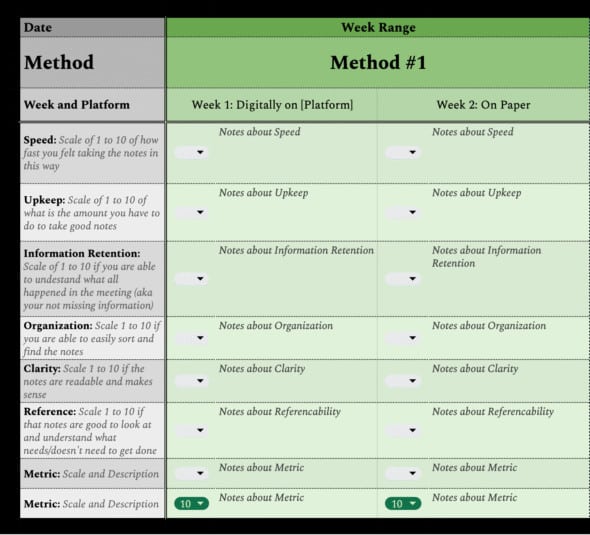
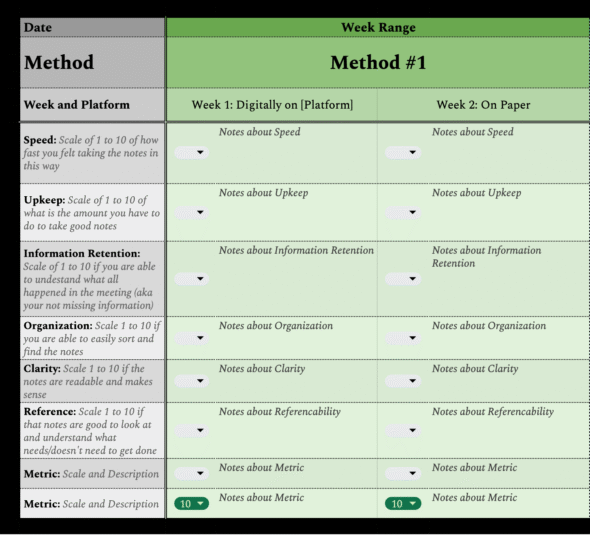
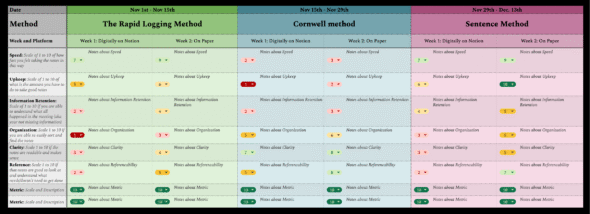
Once you’ve identified which methods to try, it’s important to determine what aspects of note-taking you’ll test the methods for. I created a spreadsheet and a testing plan to track what I learned. I used each method for two weeks. For the first week, I used a given method digitally (in Notion), and the second week, I used that same method physically in a notebook.
I wanted to evaluate speed, upkeep, information retention, organization, clarity, and ease of reference, so I set up the spreadsheet to have a column with a short description of each evaluation item. For each method, I rated each evaluation aspect on a scale of 1 to 10. I also left room for notes if I felt the need to capture specific thoughts about a method.
It’s important to keep in mind that no note-taking method will ever be a perfect fit. These methods are general methods that can’t always apply perfectly to every situation. The value of trying various methods, as I have, is that it reveals what style you find useful when taking notes. In the end, it’s likely you’ll combine multiple methods into one method perfect for you.
Final thoughts
While note-taking is important in both school and professional settings, the way you take notes can look very different. By taking the time to evaluate how you take notes, you’ll improve your ability to retain information in meetings and how you communicate it with others. If you want to evaluate your note-taking methods in a way similar to how I did, you can use my template!