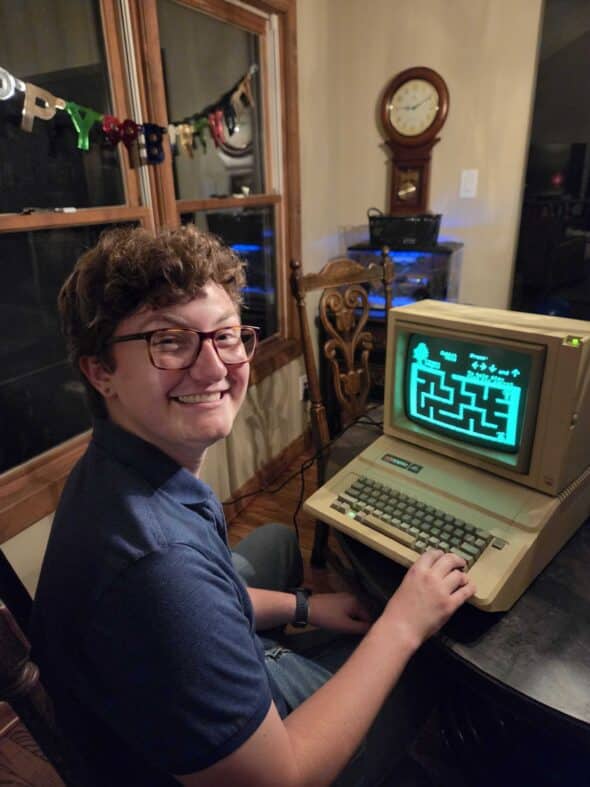

While helping clean out the garage of my grandfather’s friend, I found something that caused me to nearly drop what I was carrying.
I found an Apple IIe, Monitor II, and an Apple ImageWriter, all stored in their original packaging! Apple released the Apple IIe in January of 1983 as the “enhanced” version of the Apple II. Due to its improved expandability and appeal to personal and educational use, the Apple IIe was manufactured for almost 11 years, becoming “the longest-lived computer in Apple’s history”. After I shared pictures, a few Atoms mentioned remembering using the Apple II as a kid or as the system that introduced them to programming.
Five Minutes of Glory
Later that night I took the computer home, assembled it, connected the disk drive, warmed up the monitor, and finally turned it on. It was beautiful. I was living my vintage tech dream. After a few minutes of doing the “Intro to Apple” program, I heard a loud pop, then saw smoke coming out from the back of the computer. In panic mode, I immediately turned the computer off.
I don’t have much experience with physical computer circuits. With the vintage (and likely delicate) system, I wasn’t even certain what the problem was and if it could even be fixed. The first place I turned to was the internet to gather information. Have other Apple IIe users run into this issue?
It turns out that this isn’t as rare an issue as I thought it would be. I scoured vintage computing blogs, video tutorials, and frantic Reddit posts. Eventually, I determined the root of the issue: two tiny capacitors designed to solve a problem that we no longer have.
Encounters with Obsolete Hardware: The Dreaded “RIFA” Capacitor
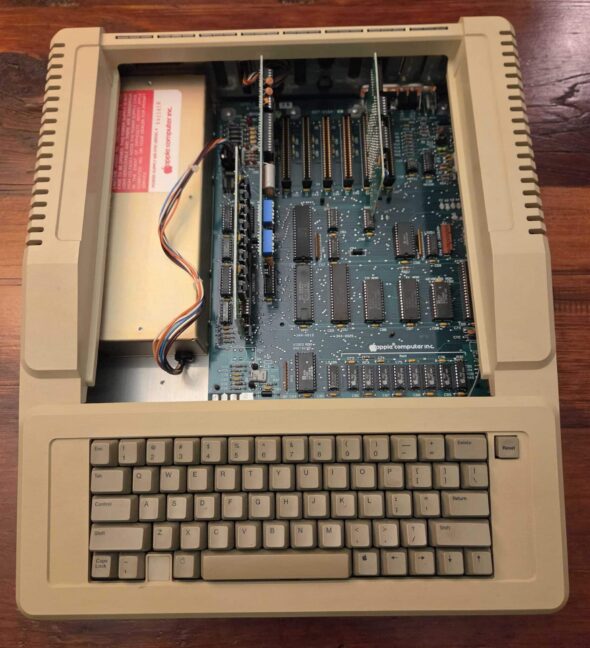
What even IS a “RIFA” capacitor? A “RIFA” capacitor, or “RIFA” cap, is a RIFA brand X2-rated safety capacitor that filters bidirectional electromagnetic interference (EMI). Essentially, it keeps electrical noise inside the device from flowing back into your house’s wiring and absorbs external noise from the power grid.
Before we can understand what a RIFA capacitor is practically used for, we have to understand analog television.
At the time of the Apple IIe’s development and release, broadcasters transmitted television through analog signals. An analog signal looks like a smooth wave that oscillates over time. Digital signal uses binary values (0 and 1s) to represent information. Cathode Ray Tube (CRT) televisions rely entirely on analog signal capture and processing. This made CRTs prone to radio frequency interference (RFI).
While RFI can affect both analog and digital signals, analog signals are much more sensitive and prone to greater distortion. RFI can create visual artifacts like wavy lines, static/grainy overlays, and color distortion, plus audio artifacts like a buzzing or popping noise.
The purpose of the RIFA capacitor is to filter RFI and other electromagnetic signals. In the 1980s, a computer without the proper RFI filters could cause significant interference problems with televisions and radios that used radio and analog frequencies.
Old CRT TVs + analog radio signal + unfiltered electrical signal from Apple = not good.
To solve this problem, Apple’s engineers added two RIFA capacitors to prevent incoming and outgoing RFI distortion.
What About Today?
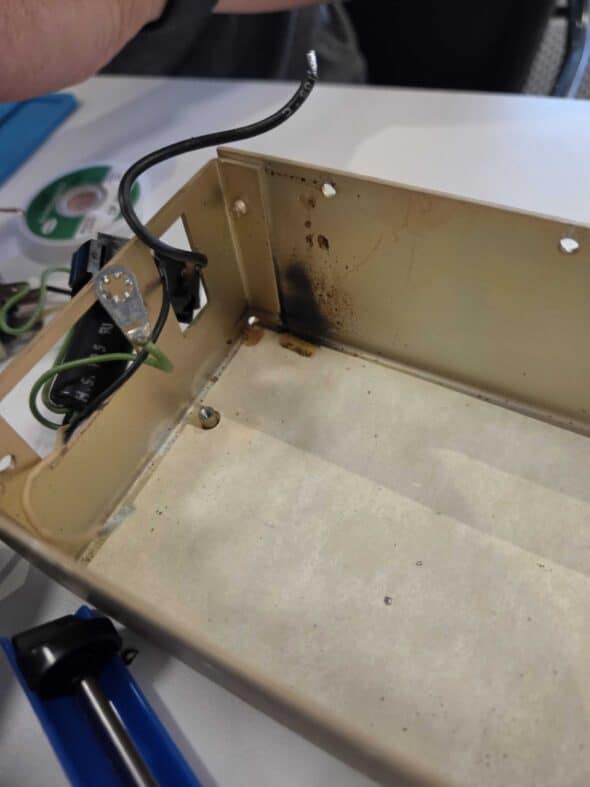
So what happened here? RIFA capacitors are “metallized paper” capacitors covered with epoxy resin casing. Over time, these enclosures crack, letting in moisture. When someone powers on the computer after 30+ years of disuse, the trapped moisture can short the capacitor. The paper inside can catch fire, explode, and release a cloud of foul-smelling smoke.
In the modern day, it’s recommended to either replace them with modern safety-rated X2 capacitors, or leave them out entirely. These capacitors are no longer completely necessary. Their main job was to filter radio frequency interference going out to analog televisions or into the CRT monitor. The United States officially switched full-power television broadcasting from analog to digital on June 12, 2009, and CRT televisions have been widely replaced by LED screens. So, the RIFA capacitors existed to solve a problem that has mostly become obsolete.
Atomic Object’s Braintrust- Not Limited to Software!
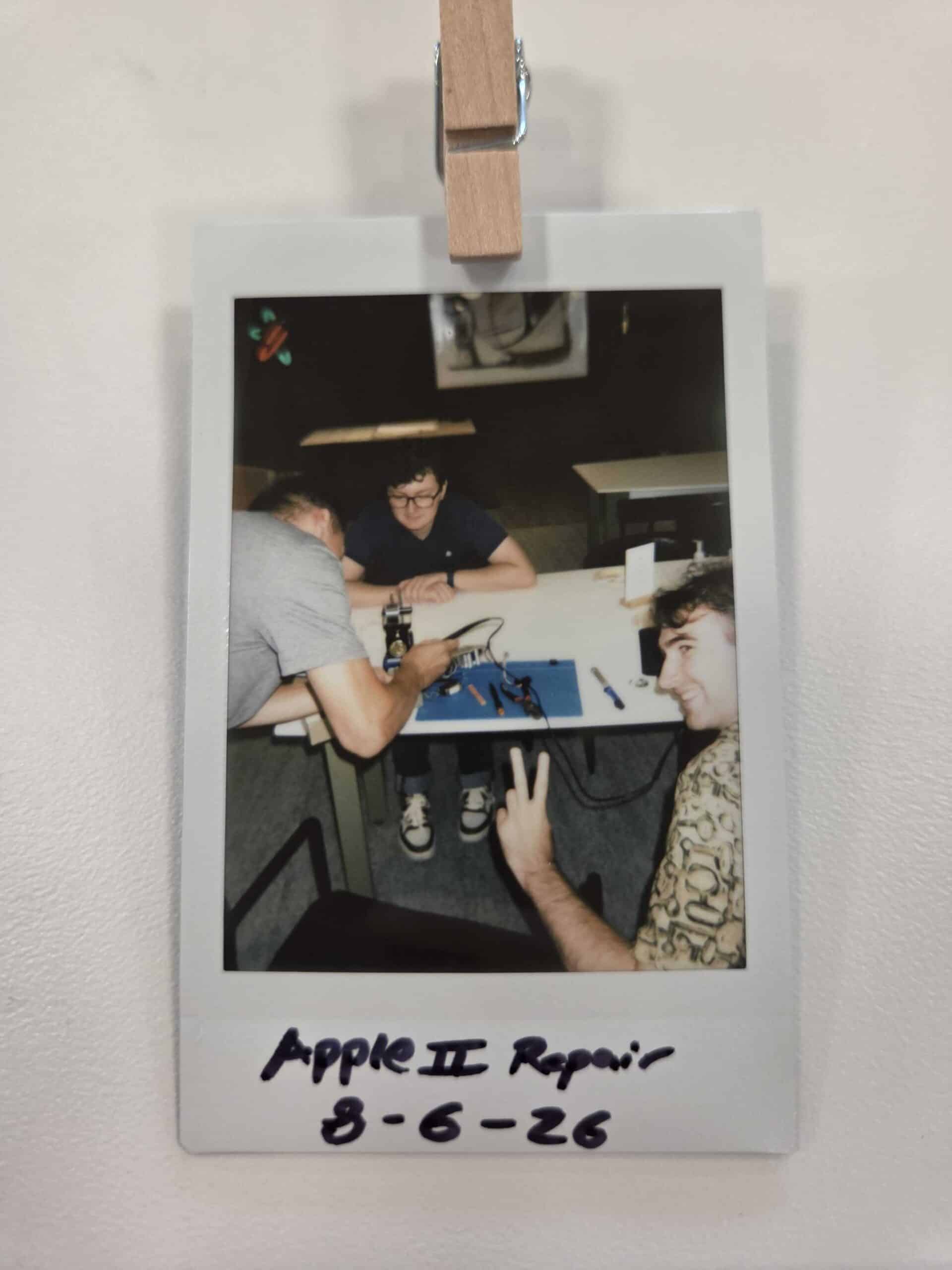
I knew I had to replace (or at least remove) the RIFA capacitors, but I had no clue how. After talking with fellow Atoms Jordan Schaenzle and Jack Burkhardt, we came up with a plan when I brought the computer’s power supply into the office. With Jordan’s experience with embedded systems and Jack’s soldering iron, we were able to de-solder the two RIFA capacitors and finally see how the capacitor blew open.
First, I removed the power supply circuit board. Then, I wiped out the blackened goop from the inside of the power supply shell using alcohol wipes. Thankfully, only one capacitor had blown, so the cleanup wasn’t too messy.
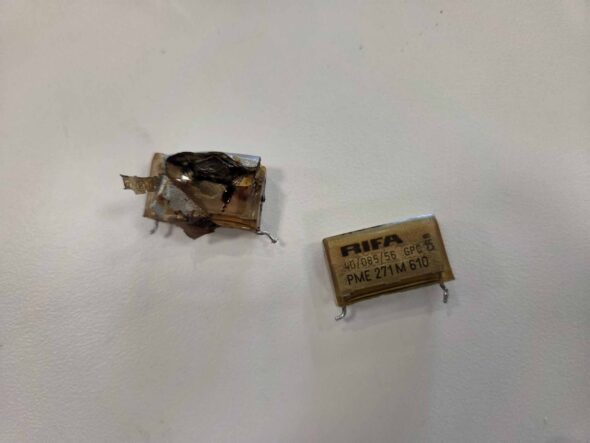
I was SO nervous to solder it myself due to my inexperience, so I appreciated Jordan and Jack’s willingness to help me out. Not only did they provide the tools, they helped me learn the skills necessary to make desoldering the capacitors a success!
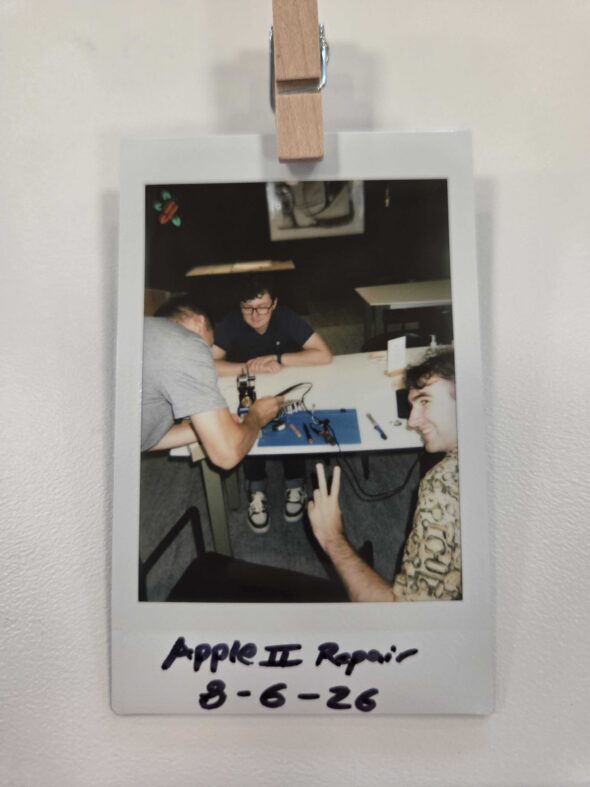
That night, I took the power supply home and placed it back inside the computer. After I reassembled the computer and checked every connection, it worked like a charm. I was so relieved that in just a few days, I went from hopeless to appreciative and excited to see what comes next for my Apple IIe.
My Biggest Takeaway?
If you are working with an older piece of hardware, do research from modern experts! You can no longer trust only the manuals that come with the hardware. Though it may be obvious to others who have a passion for vintage electronics, I had no idea that something like this could happen by just turning the computer on. It’s no wonder people now joke that RIFA stands for “Replace if found, always”.