


As a software developer, you will need to become familiar with many tools and technologies as you work and grow in the field. This is not helped by the fact that it feels like new tools are being released every day, not to mention new feature updates added to tools you already know. The easiest way to learn many of these tools is to start using them to build something. However, sometimes it can be overwhelming to decide on what to build.
One approach that has worked well for me is to stop thinking about what I should build and instead start with something I already enjoy. Framing a new tool or technology within a project tied to one of your hobbies or interests makes the process feel less like forced practice and more like natural exploration. Instead of learning in the abstract, you’re building something you actually care about. That makes it much easier to stay engaged and follow through.
Connecting New Tech And Your Interests
Once you start approaching projects for learning new technical skills as an extension of your hobbies, it can make it more interesting or motivating to work on said project. Connecting a project to something you already enjoy gives you a clearer sense of direction, rather than trying to come up with an idea from scratch.
For example, instead of thinking about learning a new framework in isolation, you can ask how it might apply to something you already spend time on. If you enjoy gaming, that could mean building a small companion tool, stat tracker, or experimenting with UI ideas inspired by games you play. If you’re into fitness, you might create a simple tracker or dashboard that fits your routine. The specifics don’t matter as much as the connection you’re using the hobby as a starting point, rather than forcing an idea from scratch.
Learning Through My Hobbies
I have found that linking technical subjects I want to explore to my non-technical interests has made the learning process more exciting. When I wanted to spend more time improving my front-end development skills and exploring different frameworks, I found it difficult to stay engaged when working through isolated tutorials or generic example projects.
Example #1
Instead, I decided to tie that goal to one of my hobbies. As someone who enjoys playing Dungeons and Dragons, I built a simple HTML page that I could open in a browser to generate six attribute scores for a fifth edition character at the click of a button. The initial version was intentionally simple, using basic HTML, CSS, and JavaScript, but it gave me a chance to experiment with small enhancements like adding sounds and simple animations.
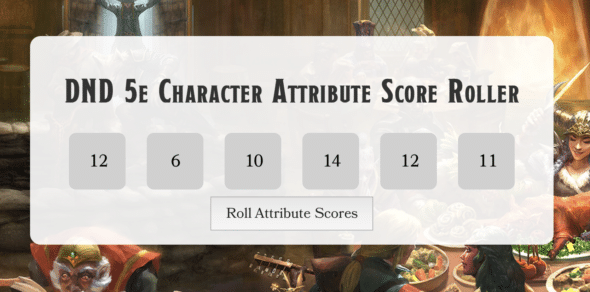
Once I had that working, the project naturally became a foundation for exploring more advanced tools. I revisited the same idea and began reimplementing it using React. This gave me a practical way to learn the framework basics while working on something I already understood. Because I was familiar with the functionality, I could focus more on how React worked rather than what I was trying to build.
Example #2
I applied a similar approach when I wanted to continue building on my front-end skills. This time, I connected it to my interest in hockey. I decided to build a Chrome extension that could display a scoreboard for NHL games using publicly available APIs. The idea was to have a simple interface where I could select a date from a calendar and see the games scheduled for that day and their start times or current scores, pending the time of looking at the schedule.

Upon selecting a game, the extension would display key information such as team logos, scores, game time, and active penalties, all surfaced in a compact scoreboard along the top of the browser. Compared to my earlier project, this one felt more intimidating at the start. There were more moving parts to think through, from working with external APIs to structuring the extension itself.
However, once I could picture clearly what the final result should look like, the process became much easier to approach. Breaking the project down into smaller steps and tying each piece back to something I was interested in made the work feel more rewarding. Each milestone, like getting the API data to load, displaying the first game, and refining the layout, felt like meaningful progress rather than just another exercise.
Applying This Approach
If you’re looking to try this approach yourself, it doesn’t need to be complicated. Start by thinking about a hobby or interest you already spend time on and ask what you could build around it. It doesn’t have to be a fully featured application; something small and focused is often the best place to start.
From there, use that idea as an opportunity to explore a tool or framework you’ve been wanting to learn. Because the project is tied to something you already understand, you can spend less time figuring out what to build and more time focusing on how the technology works. As you grow more comfortable, you can continue to expand or refine the project over time.
Closing Thoughts
As developers, it’s easy to feel like we need to constantly chase new tools or follow structured learning paths to improve. While those can be helpful, some of the most effective learning can come from simply building things connected to what you already enjoy.
By using your hobbies as a starting point, you give yourself a natural direction for projects and a stronger reason to stay engaged. Instead of forcing ideas, you’re building from genuine interest, and that often leads to better learning and more meaningful results.
If you’re unsure what to build next, start by picking something you enjoy and see where it takes you.