

Most people don’t need more stuff.
Conference t-shirts, mugs, keychains, and cheap plastic sunglasses get passed out generously by companies who paid 32 cents per item. Somewhere along the way, a well-intentioned marketer designed these with their logo plastered across them, hoping to build brand awareness. Instead of creating positive brand affinity, most items end up donated or shoved in a drawer, soon to be forgotten.
But sometimes, company swag lands differently. Someone receives something and thinks “oh, this is actually nice. I’ll use this.” They keep it, use it, and it feels less like marketing and more like a small, thoughtful gift.
The reason that happens isn’t because of budget or branding. It’s a result of how much care and thoughtfulness went into the choice.
Start With the Intent, Not the Item
Before choosing an item, it’s worth stepping back to ask why the swag exists in the first place. Is it meant to say thank you, signal your company’s values to a new audience, or create brand recall after a short interaction?
When the purpose is clear, the choices tend to get simpler.
Skipping this step often leads to the most forgettable swag. Bulk items ordered without a clear reason might check a box, but they won’t leave an impression. They’re easy to hand out, and just as easy to forget by the recipients.
Clear intent changes that. When you know what purpose the swag serves, you’re more likely to choose fewer items and choose them more carefully. That difference isn’t about budget or branding.
Let Usefulness Lead and Branding Follow
Swag doesn’t need to shout to be effective, and a loud logo might have the opposite of the intended effect. The recipient will more likely perceive it as marketing rather than something to be used.
Subtle branding signals go a lot further. A small logo, thoughtful design choices, or even a recognizable color palette can communicate brand without taking over the object itself. When something is genuinely useful, people remember where it came from.
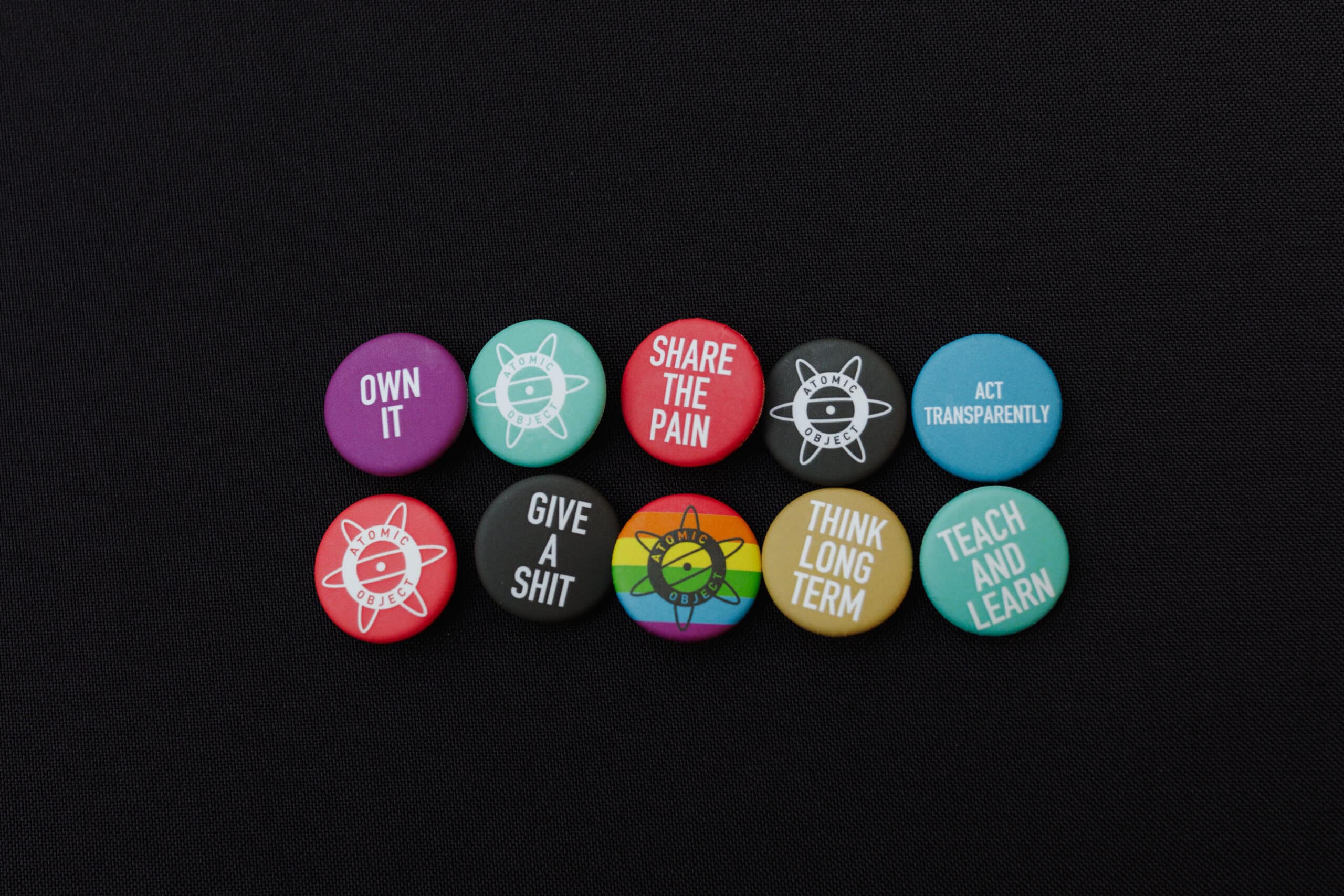
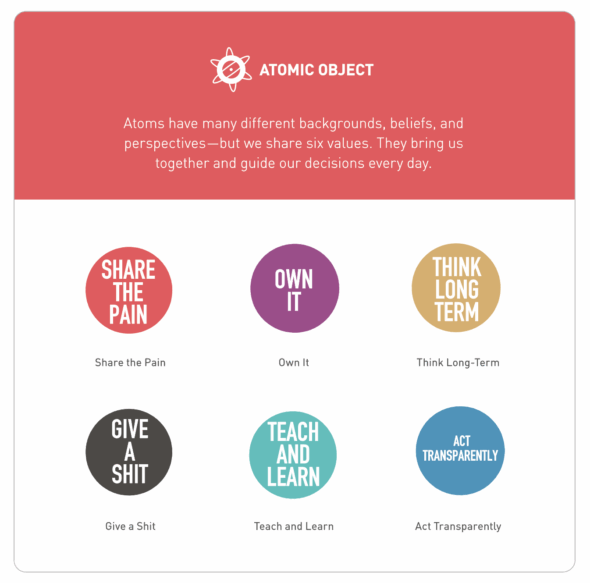
That approach is why some of our most lasting swag has been simple by design. Years ago, we created a small set of buttons featuring Atomic Object’s core values: Give a Shit, Own It, Share the Pain, Teach and Learn, Think Long Term, and Act Transparently.
Over time, we’ve heard from people outside Atomic who still keep those buttons on their desks or pinned up in their offices years later. Seeing our values resonate beyond our walls, guiding how other teams think about their work and how they treat each other, has been far more meaningful than any logo-forward item could be. It’s a reminder that when swag reflects something real, people hold onto it.
What Actually Delights People
Over time, a few patterns have emerged.
Quality Food
We’ve sent Zingerman’s gift boxes to clients and partners because they’re well-made and rooted in a local business we trust. Food gets shared, remembered, and appreciated, and it doesn’t linger unused.
Avoiding Sizing Altogether
Apparel can be tricky. If sizing isn’t handled carefully, it can be uncomfortable or exclusionary. We often choose items that sidestep that issue entirely.
Small, Meaningful Items
We choose items that reflect actual values, not marketing speak. A simple 1-inch button that says one of our company values, “Give a Shit,” consistently outperforms all of our other swag. It costs pennies to produce, weighs nothing, and requires no sizing, and people actively seek it out. When swag represents something people genuinely believe in rather than something they’re being advertised to, the size and cost become irrelevant. People wear it because it says something they believe in, not because it advertises our company.
Being Given a Choice
We don’t pass out swag bags. We lay everything out and let people choose what they want, or take nothing at all. This reduces waste immediately, since people only take what appeals to them. When someone deliberately selects something from your table, they’re already more invested. The choice matters as much as the item itself.
When you get it wrong, though, the cost is higher than just wasted money.
Marketing collateral that people don’t want isn’t marketing, it’s just waste with your name on it.
The swag people remember and talk about years later is rarely the stuff that was easiest to produce or hand out. It’s the things that were chosen with care, for a specific reason, at a moment that mattered.
That difference, between swag that delights and swag that ends up in a landfill, isn’t about budget. It’s about whether you cared enough to ask if it should exist at all.