


I recently had the good fortune of speaking at CascadiaJS (shoutout to Carter Rabasa and the whole CJS team for putting on a truly wonderful event). I wanted to take the opportunity to reflect on the content, it’s reception, and where I think we go from here.
I’ll note here that I’m specifically focusing on junior software developers, but I think this perspective is easily generalizable to other industries/roles.
The Fallacies of Junior Talent
The perception of junior talent hasn’t ever really changed. It always boils down to three things:
- They’re cheap
- They’re replaceable
- (following from the first two) They aren’t a long-term investment
I think treating junior devs like this becomes a self-fulfilling prophecy. They know they’re cheap and replaceable, so they won’t bother to stick around, and then the org has to try to squeeze as much out of them as it can before they’re gone. And this means that you can’t ever use them to build new technical capacity.
It also means juniors never really get the proper training and mentorship they need to grow and excel, because there’s no long-term investment strategy. “Just spend whatever new money you bring in. It isn’t worth investing, and a dollar today is the same as a dollar tomorrow,” is terrible financial advice. Why should we treat the people we hire differently?
The Mythical AI Month
The 800lb gorilla in the room of this conversation is AI. The common experience using these tools is that we’re moving from the more orderly, known universe of software dev into the earlier, chaotic, energetic, unknown domain of early product domain design. The additional layer of abstraction from the code makes it harder as a junior to build up the intuition and fundamentals needed to become a great software developer. And yes, I still think the term “software developer” is accurate, even if you never type a single line of code yourself.

A junior developer simply handed the keys to powerful LLMs without any guidance or mentorship is of course going to be less productive or valuable, or maybe even a negative drain, than someone more experienced. And in that environment, they’re also probably never going to grow into the more experienced kind of person you actually do want on your team. This is the natural result of viewing junior talent through the lens of the above-stated fallacies.
Thus, the industry response to this seems to be: don’t hire junior devs anymore (or maybe even senior devs), we can replace them all with AI. This veers dangerously into the territory Fred Brooks outlined half a century ago (yes, the Mythical Man Month is 50 years old). Remember that the “A” currently still stands for “Artificial”, not “Autonomous”. The more complex these systems get, the more conceptual oversight is required. Adding more AI to a late project is only going to delay it further. An infinity of monkeys at an infinity of terminals may eventually produce the complete Node.js library rewritten in Rust, but who would ever read it amidst all that slop?
Why hiring new talent is more important now than ever
To me, it’s quite obvious, despite the market hype, that these tools are only as capable as the people steering them. The skills may have changed, but the need for people hasn’t. If you want to make a purely short-term bet on maximizing the next quarter’s profits (which, unfortunately, plenty of businesses seem to want to do these days), then not bothering with junior hires is maybe the right call.
I know I want to retire someday. What happens when the current generations leave the workforce, if there’s no one left to continue the work? Even automated assembly lines still need skilled operators to make sure they continue to function, or to improve them, or to devise new and better assembly lines. If an agent falls over in a data center and there’s no human around to steer it, does it still get prompted?
Success with the Atomic Accelerator
Our Accelerator program has developed junior talent for the last decade, and it’s largely the reason we’ve grown so successfully over that time. To date, we’ve hired 75 people through the program across our 4 offices. Right now, those hires make up about 60% of our nearly 100-person dev team.
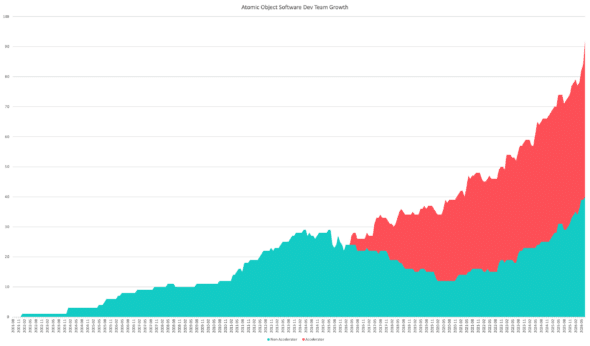
The program is structured around ongoing mentorship for the first two years on the job. This is an investment of more than 300 hours per person towards early-career professional development. And 90% of our Accelerator hires finish the program. That means they stay with us for at least two years, and they go on to have an average tenure at the company of almost 5 years. By those numbers, the investment more than pays for itself in not having to continuously rehire from churn.
But more than that, it forces us to constantly think critically about knowledge transfer, upskilling, and talent development. This feels more important than ever to me right now. That’s because all of us, from the new college grad to the most grizzled, jaded vets (can I make “deveterans” happen?), are having to relearn our approaches to work and skill building. The concept that “the best way to learn is to teach” has been around since antiquity, but became an accepted and established pedagogy in the late 20th century.
Bringing new, junior developers onto our team means the senior team has to grapple with teaching these new agentic approaches to software as they are adjusting and learning themselves. That’s making us all better developers. And we’re better consultants too, as we get more practice explaining our process and concepts ahead of presenting them to clients.
Looking ahead
So, I think we need to flip the fallacies from earlier on their head. Approach hiring junior talent as:
- They’re a long-term investment
- They’re diverse and bring new skills and perspectives to the organization
- They’re a mechanism for building institutional skills and knowledge
What it comes down to is fairly simple:
- If you’re betting on AI to replace people, then it makes sense to ignore the people you think it’s replacing.
- If you’re betting on AI to be a force multiplier for your people, then it makes sense to pay close attention to, and invest, in those people.
We’re still in a time of incredible churn and uncertainty. Right now, the developer job market feels like a bloodbath, with layoffs happening regularly and people fearful of their future prospects. But it was really just a few years ago when the situation was reversed: coming out of the pandemic, everyone was hiring and it was an extremely competitive market. And just before that, with the pandemic, everyone was getting laid off and fearful of their future prospects. And a few years before that, the 2010s saw unprecedented growth…
This pendulum will undoubtedly swing back again, so you’ve got a choice now for when it does: you can either be caught with your AI prompts down, or you can already be way ahead of the game.